AI disclosure: this content, including any imagery, was artificially generated.
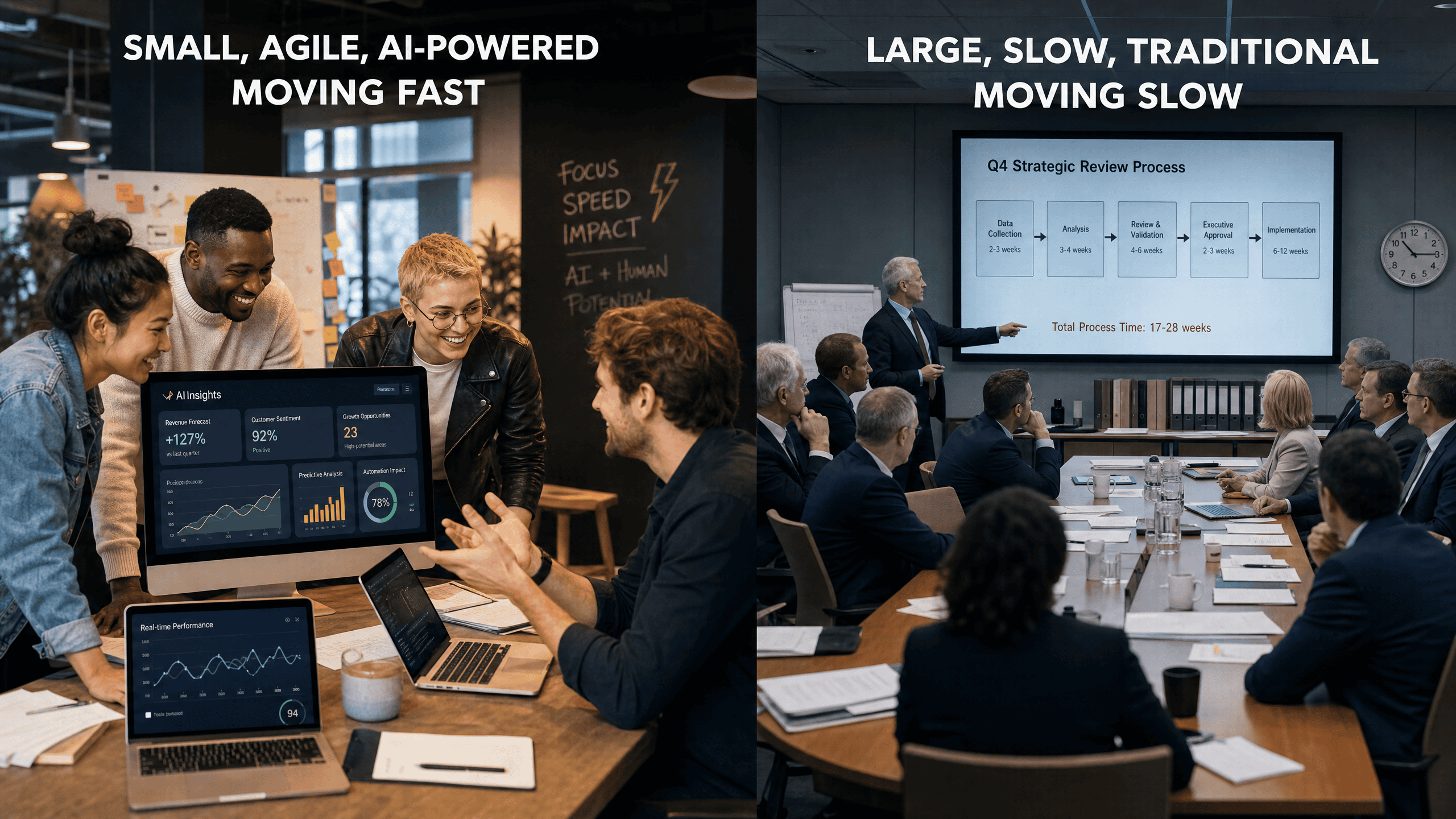
TL;DR: Replacing Traditional Management with an AI-first operating model means automating routine decisions and freeing people for strategy. These 7 proven shifts show you how. Automate smarter.
Table of Contents
Key Takeaways:
- AI systems automate routine managerial tasks and low-risk decisions, shifting human managers toward strategic planning, exception handling, and human-centered leadership.
- Continuous optimization using real-time data and predictive models shortens planning cycles, enabling rapid policy updates and performance tuning.
- Organizational roles shift to oversight, quality assurance, model validation, and explanation of AI-driven decisions.
- Decentralized decision frameworks let teams act autonomously under model-driven guardrails and APIs, increasing speed of product and process iteration.
- New governance, monitoring, data pipelines, and skills training are required to detect bias, ensure safety, and assign accountability for automated decisions.
Replacing Traditional Management: Defining the AI-First Operating Model
Distinguishing traditional hierarchy from algorithmic orchestration
You observe traditional hierarchies concentrate authority in role-based chains, while algorithmic orchestration allocates decisions to models and policy layers that act on objectives and real-time signals.
Algorithms reveal trade-offs and performance metrics directly to you, turning coordination into contract-driven interactions and reducing dependence on directional commands from individual managers.
The transition from manual oversight to automated feedback loops
As you replace periodic reviews with continuous monitoring, automated feedback loops catch drift and trigger corrective actions faster than human inspections can.
Systems feed outcome data back into models so you can refine policies, manage exceptions, and enforce governance instead of micromanaging routine tasks.
Data instrumentation and immutable audit trails give you transparent evidence for decisions, accelerate safe experiments, and clarify accountability across humans and models.
Critical Factors Influencing Model Adoption
- Data integrity and infrastructure scalability
- Organizational culture and change management readiness
- Regulatory compliance and ethical governance standards
Data integrity and infrastructure scalability
Systems require disciplined data versioning, consistent labeling, and automated validation so you avoid silent degradation in production. You should provision scalable storage, distributed training capacity, and observability to detect drift and performance regressions early.
Organizational culture and change management readiness
Teams must accept shared ownership of models, adapt KPIs to include model outcomes, and invest in targeted reskilling so you reduce friction during rollout. You should run focused pilots that surface operational gaps and collect feedback from end users.
Leadership needs to align incentives, commit budget for transition phases, and set concrete adoption milestones so you measure progress consistently. You should embed model review checkpoints into existing governance forums to keep accountability clear.
Regulatory compliance and ethical governance standards
Policies should define permissible uses, data retention limits, and acceptable risk thresholds so you can respond to audits with evidence. You should implement explainability tools, access controls, and automated logging as part of deployment pipelines.
Auditors and legal teams will demand traceability for training data, model decisions, and incident responses; you must prepare documentation and replayable traces to accelerate reviews. Perceiving compliance as continuous work helps you avoid last-minute remediation.
A Step-by-Step Guide to Decommissioning Legacy Management
| Step | Action |
|---|---|
| Mapping | Document workflows, data sources, and manual handoffs to prioritize automation targets for quick value. |
| Pilot | Run ML decision engines in shadow mode, validate against human decisions, and set rollback criteria. |
| Full-scale | Integrate models into orchestration, monitor KPIs in real time, and automate retraining pipelines. |
Mapping existing value chains for automation potential
Map current workflows, decision points, and data flows so you can spot repetitive tasks and error-prone handoffs that yield the greatest automation ROI.
Assess systems by data quality, integration ease, and exception rates to build a prioritized migration backlog you will execute in phased waves.
Pilot deployment of machine learning decision engines
Pilot an ML engine on a narrow, high-frequency process where labels exist so you can compare model outputs to human decisions without impacting customers.
Train models with representative datasets, include human-in-the-loop checks, and version artifacts so you can audit and roll back if performance degrades.
Validate performance under edge cases and define SLA thresholds plus clear rollback triggers you will enforce during staged rollouts.
Full-scale integration and real-time performance monitoring
Integrate ML engines into orchestration layers and replace manual gates with policy-driven automation while you instrument end-to-end telemetry for latency and business KPIs.
Establish monitoring, alerting, and automated retraining pipelines and assign cross-functional owners so you can maintain model health and governance over time.
Optimize feedback loops by feeding human corrections into training data and automating feature updates to reduce model drift windows you must manage.
Pros and Cons of Algorithmic Management
| Pros | Cons |
|---|---|
| Efficiency gains and faster decision cycles | Worker surveillance and privacy concerns |
| Scalability without linear headcount increases | Algorithmic bias reproducing past injustices |
| Objective, data-driven performance metrics | Loss of tacit institutional knowledge |
| Continuous optimization through feedback loops | Over-reliance on models that may fail |
| 24/7 operational consistency | Reduced worker autonomy and creativity |
| Lower administrative overhead for routine tasks | Explainability and transparency gaps |
| Faster onboarding via standardized workflows | Single-point model failures creating systemic risk |
| Clearer data to inform strategic choices | Regulatory and compliance exposure |
Efficiency gains and the elimination of human bottlenecking
You experience measurable throughput improvements as algorithms route tasks, prioritize work, and remove manual approvals that once slowed teams.
Automated orchestration lets you reassign people to higher-value work while the system handles repetitive coordination and scheduling, shortening cycle times.
Risks of algorithmic bias and the erosion of institutional knowledge
Algorithmic decisions often mirror historical patterns, so you can inherit unfair outcomes unless models and data are actively audited for bias.
Data fragmentation and opaque decision rules mean you might lose tacit knowledge when expertise is displaced by opaque models, making recovery difficult.
Mitigation requires you to maintain human review points, document informal rules, and implement continuous monitoring so organizational memory and fairness survive the shift to algorithmic control.
Strategic Tips for Sustaining an AI-First Culture
- You redefine decision rights, metrics, and escalation paths for AI-driven choices
- You fund and schedule hands-on AI training tied to real tasks
- You align policies and incentives to reward model-informed outcomes
Redefining leadership roles from controllers to architects
Leaders reconceptualize their role as designers of autonomous processes and data governance, guiding teams to set objectives, guard quality, and interpret model outputs.
You shift from approving every decision to specifying constraints, KPIs, and escalation paths while enabling cross-functional feedback loops that keep models aligned with business goals.
Implementing continuous upskilling and AI literacy programs
Teams require regular, applied training that builds practical AI fluency, so you run hands-on workshops, model clinics, and simulation exercises tied to real workflows.
You measure progress with competency rubrics, rotation programs, and micro-credentials that make AI skills visible in performance reviews.
Offer bite-sized modules, mentorship pairings, on-demand labs, and curated external certifications that fit into sprint cycles; set aside learning hours and link completion to career pathways.
Recognizing continuous learning as an operational priority signals to staff that AI skills are part of everyday work.
To wrap up
Drawing together you can see how the AI-first operating model redistributes decision-making, automates routine tasks, and speeds iterative learning.
The shift demands that you redesign workflows, reskill teams, and set measurable guardrails for algorithmic decisions. You must pair human judgment with continuous monitoring to preserve fairness and deliver outcomes.
Key Takeaways: Replacing Traditional Management
- Start by replacing traditional management of routine decisions — automate the repeatable first.
- Replacing Traditional Management frees strategic time — people move to exception handling and planning.
- Data discipline underpins replacing traditional management — clean inputs make algorithmic management trustworthy.
- Replacing Traditional Management needs new metrics — measure outcomes, not hours managed.
- Culture decides replacing traditional management — an AI-first culture sustains the shift long term.
Apply Replacing Traditional Management to Your Operating Model
Ready to start replacing traditional management in your own company? Begin with these guides.
- Beginner guide to replacing traditional management with AI automation
- AI tools that help with replacing traditional management
- Track what replacing traditional management actually saves you
For the wider trend, see this Deloitte intelligent automation report.
FAQs: Replacing Traditional Management
Q: What is the AI-first operating model?
A: The AI-first operating model reorganizes decision-making and workflows so machine intelligence is the primary engine for routine choices and optimization.
It embeds data, models, and automated pipelines into core processes to reduce manual coordination and speed execution. Teams concentrate on defining objectives, monitoring model health, and handling edge cases where automation falls short.
Q: How does the AI-first model replace traditional management roles?
A: Managers shift from directing every task to specifying goals, constraints, and success metrics that models must meet.
Routine reporting, scheduling, and performance tracking become automated, allowing managers to focus on strategy, complex problem solving, and talent development.
Organizational roles evolve toward system design, model stewardship, and exception resolution.
Q: What technologies and capabilities are required to adopt this model?
A: Adoption requires scalable data pipelines, model training and deployment platforms, observability tooling, and MLOps practices that support continuous improvement.
Teams need skills in data engineering, model evaluation, prompt design, and ethics-aware review processes. Processes for versioning, explainability, and fast human-in-the-loop feedback are vital for safe operation.
Q: What risks should organizations manage when moving to an AI-first model?
A: Common risks include model bias, degraded performance over time, over-reliance on automated outputs, privacy exposure, and regulatory noncompliance.
Risk controls include clear ownership, audit trails, periodic model audits, user feedback channels, and defined human override policies.
Legal and security reviews must be integrated into development cycles with comprehensive logging for accountability.
Q: How should a company transition from traditional management to an AI-first operating model?
A: Launch pilot projects that target high-impact, low-risk processes to demonstrate value and learn build-measure cycles. Form cross-functional teams of domain experts, engineers, and data scientists with authority to deploy and iterate on models.
Define metrics for both model performance and business outcomes, codify successful practices into standard procedures, and train staff on new roles and oversight responsibilities.